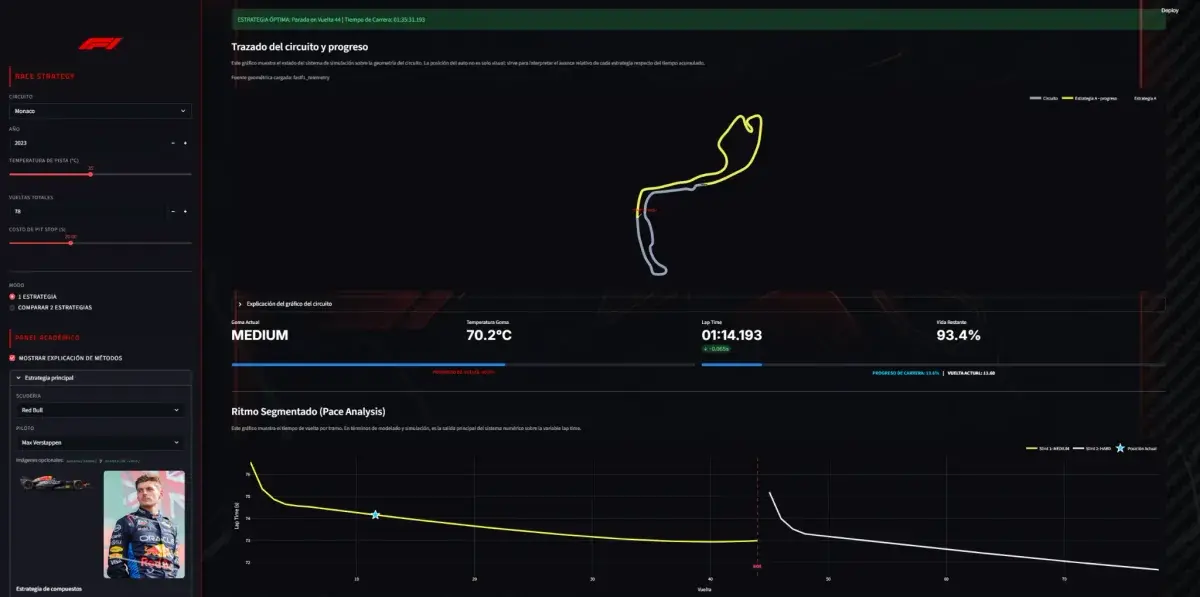
Compare race strategies under the same simulation conditions.
Circuit, temperature, compounds and stops feed a pace and wear simulation. It combines available historical data, synthetic variables and simplified models. Independent project with no affiliation with Formula 1, the FIA or teams.
Problem
Connect tyre behavior to lap times and compare one-stop and two-stop strategies through understandable charts.
My role
I participated in collaborative development and simulator adjustments, contributing to the integration of the strategy analysis and comparison experience.
02
Architecture
Streamlit brings together controls and charts. An extractor retrieves FastF1 data and prepares datasets; a polynomial expansion, scaling and Ridge regression pipeline estimates times. EngineEstrategia integrates temperature and simulates stints; numerical utilities implement RKF45, Simpson, polynomial fitting and Newton-Raphson.
03
Technical decisions
Historical data with a fallback
Extraction attempts to load sessions and telemetry through FastF1 with a local cache. The pipeline also generates synthetic samples and uses a fallback dataset when retrieval fails; circuit geometry can use a stylized layout.
Compare within a model
Strategies share circuit, temperature and pit-time-loss conditions. The engine combines pace estimation with thermal evolution and wear to compare cumulative times and crossover points, without turning them into official predictions.
04
Challenges and solutions
Telemetry availability and changing circuit conditions affect model inputs. Caching, synthetic data and fallback geometry support exploration. Wear curves and configurable parameters require results to be interpreted as simulator estimates.
05
Outcomes
The interface simulates and compares one-stop and two-stop strategies, replays circuit progress and shows pace, temperature, tyre life and cumulative differences. A methods panel explains the integrated calculations. These are simplified estimates, without validation for real racing decisions.
06
Gallery and resources
Gallery
Monaco circuit and strategy progress in the independent simulator.Estimated pace, temperature and tyre life under the simplified model.Two pit-stop strategies compared under the same simulation conditions.Estimated lap-time, cumulative-difference and wear charts; these are not official predictions.