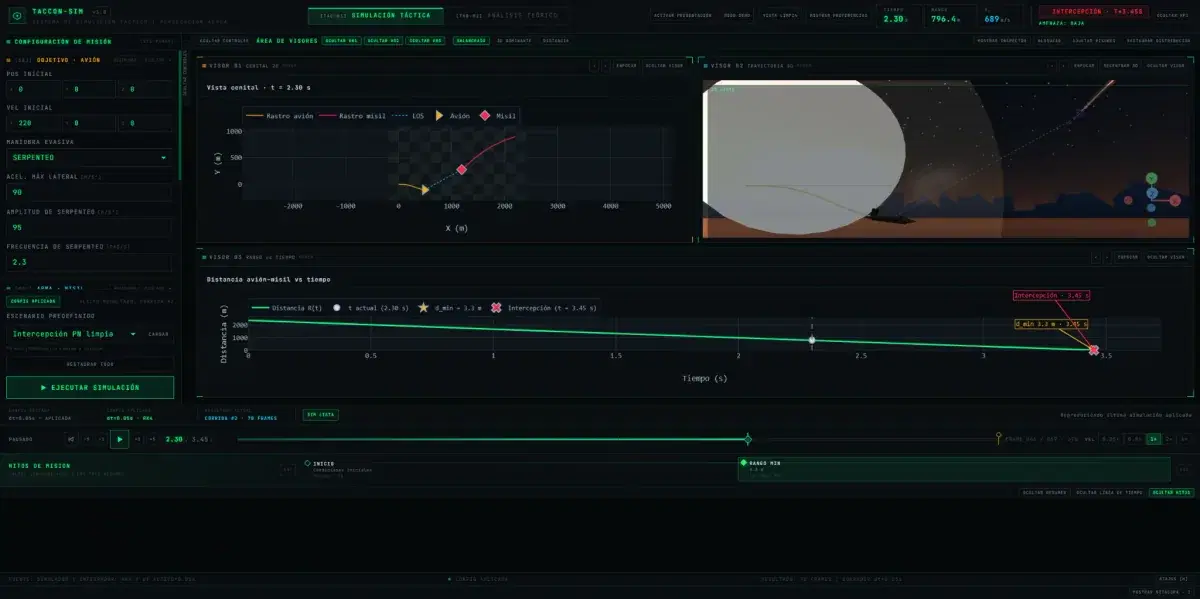
One result, coordinated views
The SimulationResult contract keeps time series and configuration metadata. Trajectories, distance and playback can use the same result without redefining calculations in each chart.
One trajectory, multiple perspectives.
Explore an aerial pursuit through trajectories, distances and equations.
A React application connects configurable scenarios with 2D/3D views, distance analysis and playback controls. It is a simplified numerical model, without validation of professional physical accuracy or integration with real systems.
Relate pursuit configuration to its evolution over time and examine the same result through different visualizations.
I contributed to development and adjustments of the collaborative simulation application, working within a solution that brings together numerical computation and interactive visualization.
The TypeScript engine separates dynamics, guidance, maneuvers and Euler/RK4 integrators. simulate returns position, velocity and distance series together with the encounter outcome. React coordinates configuration and playback; Plotly displays curves and Three.js/React Three Fiber the 3D scene. KaTeX renders equations.
The SimulationResult contract keeps time series and configuration metadata. Trajectories, distance and playback can use the same result without redefining calculations in each chart.
Euler and RK4 share a derivative function and the configured time step. The engine records the selected integrator and stops at the encounter radius or maximum time. Repository tests cover numerical logic and guidance.
The simulation transforms vector states into comparable series and an encounter outcome. The engine computes minimum distance and encounter time, while the graph workspace supports trajectory and distance inspection. Theoretical stability includes a didactic approximation and does not constitute full physical validation.
Scenarios support guidance and maneuver exploration, trajectory playback, 2D/3D visualization and distance-over-time analysis. The theory section presents equations and procedures. The repository includes integrator, dynamics, guidance and simulation tests.